
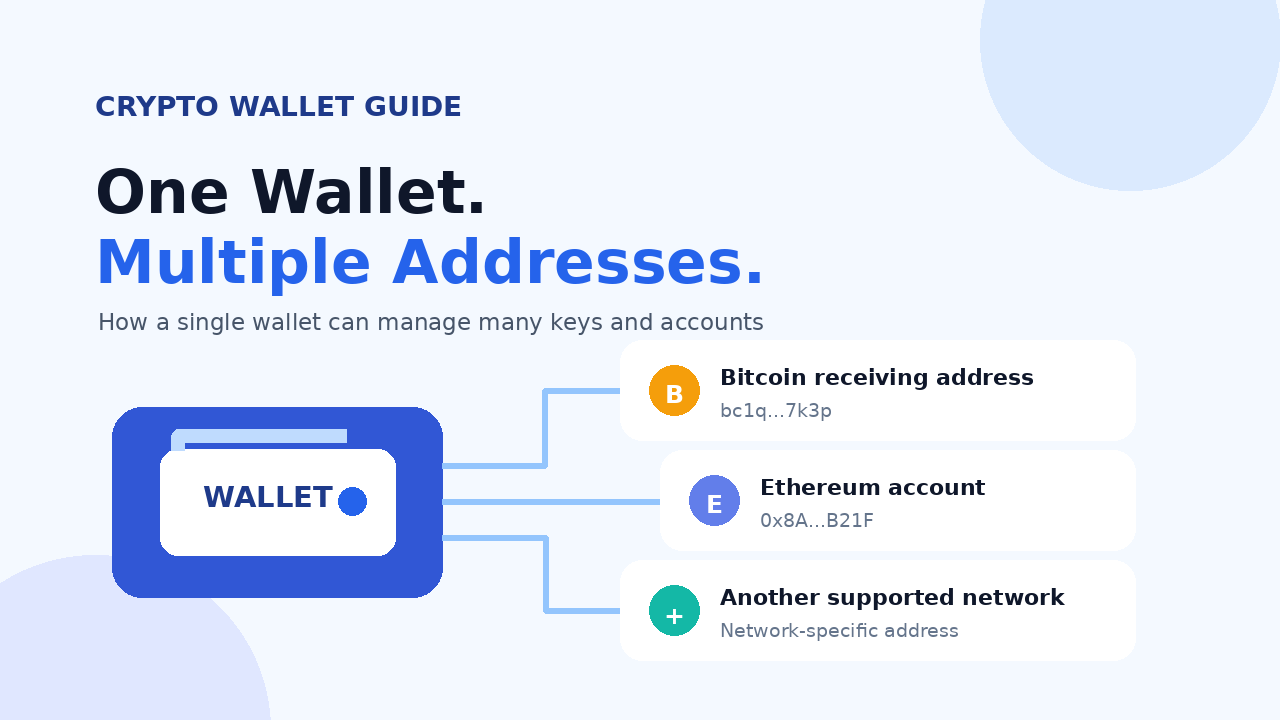
Can one crypto wallet have multiple addresses? Yes. A wallet is an interface for managing cryptographic keys and blockchain accounts; it is not limited to a single public address. The exact behavior depends on the network and wallet design.
Bitcoin wallets commonly generate fresh receiving addresses, while an Ethereum wallet may hold several accounts that each keep a persistent address. A multi-chain wallet can also show different addresses for different networks.
Quick answer: One recovery seed can derive many keys, and a wallet can use those keys to manage multiple addresses. A new address does not automatically mean you created a new wallet.
Wallet vs. address: the important difference
A crypto wallet is software or hardware that helps you manage keys, sign transactions and read blockchain data. A wallet address is a public identifier used to receive assets or identify an account on a particular network.
This distinction is easier to understand once you know where cryptocurrency is actually stored. The assets remain recorded on the blockchain; the wallet manages the keys that let you interact with them.
- Wallet: manages keys, accounts and network activity.
- Private key: authorizes actions for a particular account or derived address.
- Address: a public destination or account identifier on a blockchain.
How one wallet creates multiple addresses
Many modern wallets use a hierarchical deterministic (HD) structure. Instead of generating unrelated keys that each require a separate backup, an HD wallet starts with root seed material and derives a tree of child keys.
The deployed BIP 32 specification describes how a tree of key pairs can be derived from one seed. Wallet software handles this process in the background, so a user can back up the recovery information rather than recording every derived key separately.
Seed → master key → derived keys → multiple addresses
This does not mean every wallet, blockchain or recovery system behaves identically. Derivation paths, supported networks and imported accounts can differ between applications. Before restoring a wallet elsewhere, confirm that the new application supports the same network and derivation method.
Bitcoin and Ethereum handle addresses differently
| Feature | Bitcoin wallet | Ethereum wallet |
|---|---|---|
| Typical receiving behavior | Often shows a fresh receiving address | An individual account normally keeps one address |
| Multiple addresses | Commonly derived and managed in one wallet | Usually appear as multiple accounts in one wallet app |
| Why users see more than one | Address reuse reduction, account structure and change handling | Additional accounts or imported accounts |
| Balance display | The wallet can combine activity from several addresses | Balances are generally shown per account and network |
Why Bitcoin wallets generate new receiving addresses
Bitcoin transactions are public and permanently recorded. Reusing one receiving address can make it easier for observers to connect payments involving that address. Bitcoin.org therefore recommends using a new Bitcoin address for each new payment as a privacy practice.
You can read the reasoning in Bitcoin.org’s official guide to protecting privacy and avoiding address reuse. A compatible wallet can generate fresh addresses while continuing to monitor earlier addresses that it controls.
If your Bitcoin wallet displays bc1...AddressA today and bc1...AddressB later, both can belong to the same wallet. Seeing a new receive address is usually normal behavior, not evidence that the first address has been lost.
Does an old Bitcoin address stop working?
Generating a new receiving address does not, by itself, make an older address expire. If the wallet still controls the corresponding key and can discover the address during recovery, it can generally recognize funds sent there.
However, you should follow the instructions shown by your specific wallet. Some services assign deposit addresses, rotate them or require a memo or tag. Always confirm the currently supported deposit method before sending funds, especially when an exchange or custodian is involved.
Can an Ethereum wallet have multiple addresses?
Yes, but the user experience is different from a typical Bitcoin wallet. On Ethereum, an externally owned account is controlled by a key pair and has its own address. Ethereum.org also makes the useful distinction that an account is not a wallet; the wallet is the interface used to interact with the account.
The official Ethereum accounts documentation explains how externally owned accounts, keys and addresses relate. A wallet application can manage Account 1, Account 2 and Account 3, each with a different 0x... address.
For a practical example, MetaMask explains that accounts holding tokens can be derived from a Secret Recovery Phrase and that each account has its own private key. Imported accounts may work differently, so they should be backed up according to the wallet provider’s instructions.
Are multiple addresses the same as multiple wallets?
No. One wallet can manage several addresses, while two separate wallets may use different recovery information.
- Wallet A: Recovery Seed A → Address 1, Address 2 and Address 3.
- Wallet B: Recovery Seed B → Address 4 and Address 5.
Wallet A still represents one wallet structure even though it controls three addresses. Wallet B is separate because it relies on different recovery information. The exact labels used by apps—wallet, account, portfolio or vault—can vary, so focus on which keys or recovery method control each address.
Can one wallet manage different blockchains?
Many multi-chain wallets support accounts across Bitcoin, Ethereum, Solana and other networks. That can place several network-specific addresses inside one interface, but those addresses are not interchangeable.
- A Bitcoin address should be used on the supported Bitcoin network.
- An Ethereum-style
0x...address may appear on multiple EVM-compatible networks. - A matching-looking address does not mean two networks share balances or transaction history.
Some EVM-compatible networks can display the same 0x... address when the same key is used. Each network still maintains its own balances, tokens, contracts and transaction history. Always verify both the address and the selected network before sending.
Does each address have a separate balance?
Blockchain data is associated with network-specific addresses, accounts, scripts or transaction outputs. Wallet software can collect that information and present a combined total.
For example, a Bitcoin wallet might track 0.01 BTC connected with one address, 0.02 BTC with another and 0.03 BTC with a third, then display a total wallet balance of 0.06 BTC. The interface looks like one balance even though the wallet is monitoring several addresses behind the scenes.
Safety checks before using a wallet address
- Confirm the network. The destination must support the blockchain you are using.
- Use the address shown by the wallet or service. Do not assume an old deposit address is supported by a custodial platform.
- Check the beginning and end. Malware can replace copied addresses.
- Look for a memo or destination tag. Some networks and exchanges require one.
- Test with a small amount when appropriate. Blockchain transactions are generally difficult or impossible to reverse.
- Never share a seed phrase or private key. A receiving address is public; recovery secrets are not.
Frequently asked questions
Can one Bitcoin wallet have multiple addresses?
Yes. Modern Bitcoin wallets commonly manage many receiving and change addresses. An HD wallet can derive them from one underlying seed structure.
Can one seed phrase recover multiple addresses?
Yes, when those addresses were derived through a compatible deterministic wallet structure. Successful recovery depends on the wallet, derivation path and supported blockchain.
Why does my Bitcoin receiving address keep changing?
Your wallet may be generating fresh addresses to reduce address reuse. Earlier addresses can still be controlled by the same wallet when their keys remain part of its recoverable structure.
Can one Ethereum wallet contain several accounts?
Yes. A wallet application can manage several Ethereum accounts, each with its own address and private key.
Can the same address appear on multiple networks?
It can on compatible networks that derive an account from the same key. The networks still have separate balances and transaction histories, so the selected network must be verified.
Final answer
One crypto wallet can have multiple addresses because the wallet manages keys and accounts rather than acting as a single address. Bitcoin wallets often derive fresh receiving addresses, Ethereum wallets can manage multiple accounts, and multi-chain wallets can show addresses for several networks.
The simplest rule is: the wallet manages the keys; the addresses identify destinations or accounts on a blockchain. Always verify the address, network and any required memo before transferring assets.