
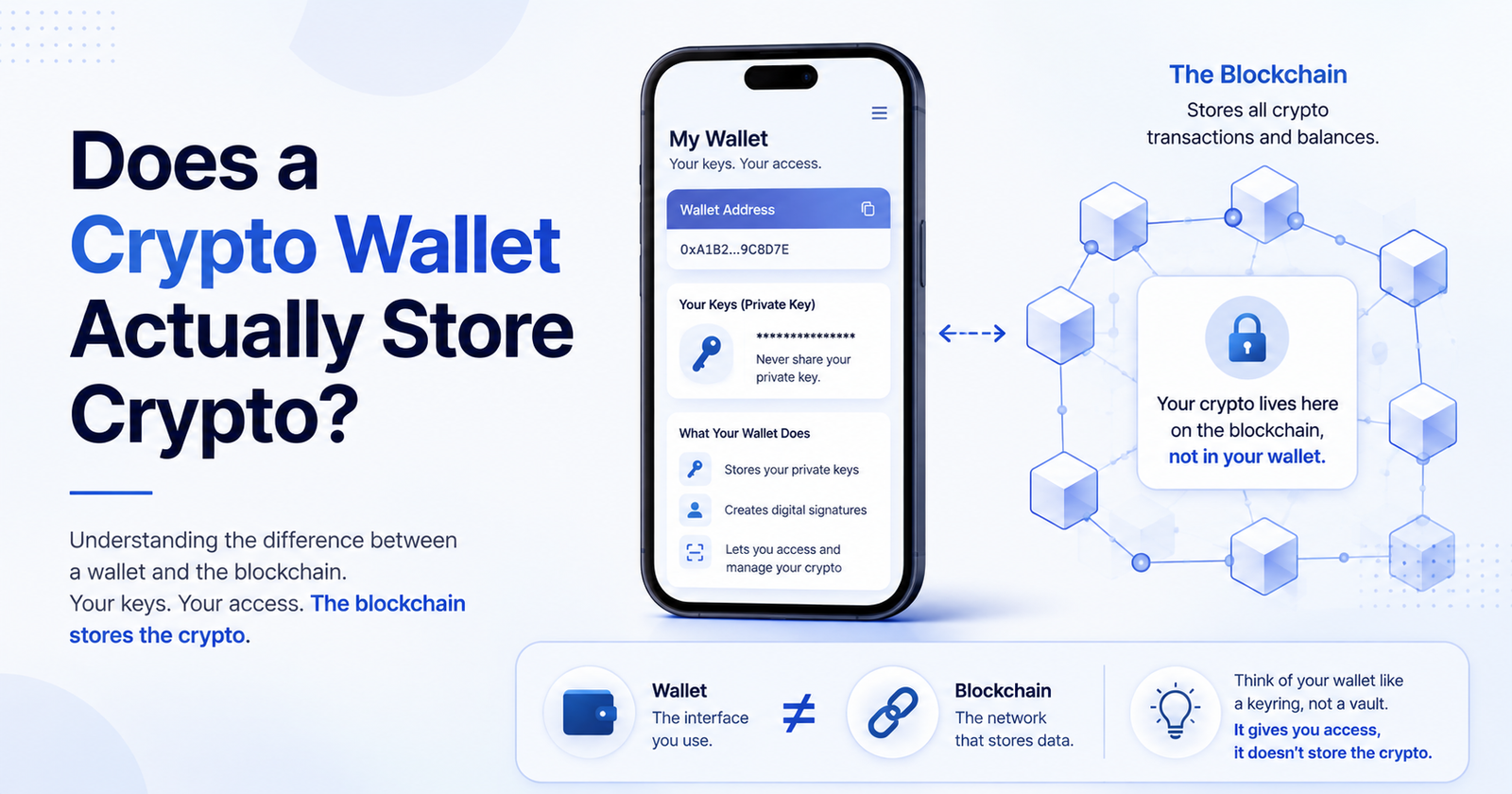
A crypto wallet does not actually store cryptocurrency inside the app, phone, browser extension, or hardware device.
Your cryptocurrency exists as records on a blockchain. The wallet gives you a way to access and control those assets by managing the cryptographic keys associated with your blockchain addresses.
This can be confusing because apps often show a balance that makes it look as if your Bitcoin, Ethereum, or other crypto is sitting inside the wallet itself.
It is not.
Understanding where cryptocurrency is actually stored makes concepts such as wallet recovery, seed phrases, hardware wallets, and blockchain addresses much easier to understand.
Does a Crypto Wallet Store Your Coins?
No. A crypto wallet does not physically store your coins or tokens.
Instead, the blockchain keeps a record of which addresses control which assets.
Your wallet interacts with that blockchain and uses cryptographic keys to prove that you have permission to move assets associated with your address.
A simple way to think about it is:
- Blockchain: Keeps the record of the assets.
- Wallet address: Identifies where those assets are assigned.
- Private key: Provides the cryptographic authority needed to control them.
- Crypto wallet: Manages the keys and provides an interface for interacting with the blockchain.
This is why your crypto can still exist even if your wallet application is deleted.
The assets were never inside the application in the first place.
Where Is Cryptocurrency Actually Stored?
Cryptocurrency is recorded on its blockchain.
For example, Bitcoin transactions are recorded on the Bitcoin blockchain. Ethereum and Ethereum-based token activity is recorded on Ethereum.
The blockchain contains information about transactions and the current state of addresses.
When someone sends cryptocurrency to your wallet address, the sender is not placing digital coins inside your phone.
Instead, a new blockchain transaction updates the network’s records.
After the transaction is confirmed, the blockchain reflects that the relevant assets are now associated with your address.
Your wallet reads this blockchain information and displays your balance.
This is why the same balance can often be viewed through a blockchain explorer even when your wallet application is closed.
What Does a Crypto Wallet Actually Store?
A non-custodial crypto wallet primarily manages the cryptographic information needed to control blockchain addresses.
Depending on the type of wallet, this can include:
- Private keys
- Public keys
- Wallet addresses
- A seed phrase or information derived from it
- Transaction history retrieved from the blockchain
- Network and token information
- Wallet preferences and account labels
The most important part is the private key.
A private key is a secret cryptographic value that allows transactions to be authorized from a particular blockchain address.
Many modern wallets use a seed phrase to generate multiple private keys and addresses.
The wallet then handles this technical process in the background so that users do not have to manage individual keys manually.
How Does a Wallet Access Crypto on the Blockchain?
Suppose someone sends cryptocurrency to your address.
The blockchain records the transaction.
When you open your wallet, the wallet checks the relevant blockchain network and identifies assets associated with the addresses it manages.
It then displays those assets as your wallet balance.
If you later decide to send some of the crypto elsewhere, your wallet creates a transaction and uses your private key to generate a cryptographic signature.
That signature proves to the network that the transaction was authorized by someone who controls the appropriate private key.
The private key itself does not need to be sent to the blockchain.
This distinction is important.
Your wallet is not taking crypto out of internal storage. It is using your keys to authorize a change to the blockchain’s records.
What Is the Role of a Private Key?
The private key is one of the most important parts of a non-custodial crypto wallet.
It provides the cryptographic ability to authorize transactions associated with your blockchain address.
A simplified relationship looks like this:
Private key → Public key → Wallet address
The exact process differs between blockchain systems, but the important concept is that your private key should remain secret.
Your public wallet address can be shared with someone who wants to send you crypto.
Your private key should not be shared.
If another person obtains the private key controlling an address, they may be able to authorize transactions from that address.
This is why protecting private keys and seed phrases matters much more than protecting the wallet application’s balance screen.
Does a Hardware Wallet Actually Store Crypto?
A hardware wallet does not store cryptocurrency inside the physical device either.
The crypto remains recorded on the blockchain.
What a hardware wallet is designed to protect is your private key.
With a hardware wallet, sensitive signing operations can take place within the hardware device instead of exposing the private key directly to an internet-connected computer.
Imagine that your hardware wallet shows a Bitcoin balance.
Those bitcoins are not sitting inside the USB-like device.
The Bitcoin blockchain contains the relevant transaction records. The hardware wallet holds or derives the cryptographic keys required to authorize transactions associated with your addresses.
This also explains why losing the physical device does not automatically mean the cryptocurrency disappears.
If the wallet was properly backed up and the recovery information remains available, access may be restored using a compatible wallet.
What Happens If You Delete Your Crypto Wallet App?
Deleting a non-custodial wallet application does not delete cryptocurrency from the blockchain.
Your blockchain addresses and their transaction history continue to exist.
However, deleting the wallet can become a serious problem if you also lose the information required to restore access.
For example, imagine your wallet contains access to an address holding ETH.
You delete the app.
The ETH remains associated with that address on Ethereum.
If you reinstall the wallet and correctly restore it using the appropriate recovery information, the wallet can regenerate or recover the relevant keys and identify the same blockchain assets again.
But if you permanently lose the private keys or recovery information, the blockchain does not provide a password-reset system that can simply restore access.
The assets still exist on the blockchain, but you may no longer have the cryptographic credentials required to control them.
What Happens If You Lose a Hardware Wallet?
Losing a hardware wallet does not remove cryptocurrency from the blockchain.
Again, the physical device is not where the cryptocurrency itself is stored.
What matters is whether you can recover the keys associated with your addresses.
Many hardware wallets provide a recovery phrase when the wallet is first created.
That recovery phrase can usually be used to recreate the wallet’s keys using compatible software or another device.
For example:
You have a hardware wallet.
Your address holds crypto according to the blockchain.
The hardware wallet is lost.
The blockchain record does not change.
If you recover the wallet correctly using your backup, you can regain control of the same blockchain addresses.
This is another reason why understanding the difference between crypto ownership records and wallet devices is so important.
Custodial Wallets Work Differently
There is an important distinction between custodial and non-custodial wallets.
With a non-custodial wallet, you normally control the private keys or the recovery information needed to derive them.
With a custodial wallet, such as an account managed by a centralized platform, the service provider may control the private keys on your behalf.
The app can still display a crypto balance, but the underlying key management structure is different.
In some cases, the balance shown inside a custodial platform may also represent an internal account balance rather than a separate blockchain address dedicated exclusively to you.
So the statement that “a wallet stores private keys” applies most directly to non-custodial wallets.
The broader principle remains the same: cryptocurrency itself exists through blockchain records, not as files stored inside a wallet application.
Wallet vs Blockchain: A Simple Example
Imagine Alice sends Bob 0.01 BTC.
Bob gives Alice his Bitcoin address.
Alice creates the transaction.
The Bitcoin network processes and confirms it.
The blockchain now reflects the transaction involving Bob’s address.
When Bob opens his wallet, the wallet checks the blockchain and displays the balance associated with the addresses it controls.
Bob’s phone did not receive a Bitcoin file.
Nothing was physically downloaded into his wallet.
The blockchain changed.
Bob’s wallet simply provides the keys and interface needed to interact with that blockchain record.
This is why cryptocurrency can be received even when a wallet application is not currently open.
The blockchain does not depend on the recipient’s wallet application being active in order to record a transaction.
Why Does a Wallet Look Like It Stores Crypto?
Wallet interfaces are intentionally designed to make cryptocurrency easier to understand and use.
Instead of showing users raw blockchain data, they usually display:
- Your total balance
- Individual tokens
- Recent transactions
- Receive addresses
- Send options
- Network information
Because everything appears inside one application, it is natural to assume that the cryptocurrency itself is stored there.
A banking app creates a similar visual impression.
You see money represented inside an application, but the application itself is simply an interface to an underlying financial system.
A crypto wallet works differently from a bank account technically, but the interface concept is similar.
It helps you interact with something that exists outside the application itself.
Why This Difference Matters
Knowing where cryptocurrency actually exists helps explain several common wallet questions.
It explains why:
- Deleting a wallet app does not delete blockchain assets
- A hardware wallet can be replaced
- Your wallet can display the same assets after recovery
- Blockchain explorers can show an address balance without accessing your wallet
- Multiple wallet applications can sometimes restore the same addresses using the same recovery information
- Protecting your private keys or recovery phrase is extremely important
Most importantly, it separates two concepts that beginners often mix together:
Your wallet is the tool used to access crypto.
The blockchain is where the ownership and transaction records exist.
Frequently Asked Questions
Is Bitcoin stored inside a Bitcoin wallet?
No. Bitcoin is represented through records on the Bitcoin blockchain. A Bitcoin wallet manages the cryptographic keys needed to interact with Bitcoin addresses.
Is Ethereum stored inside MetaMask or another wallet?
No. ETH and Ethereum tokens exist as blockchain records. A compatible wallet allows you to interact with the addresses and smart contracts associated with those assets.
Does a hardware wallet contain my cryptocurrency?
No. A hardware wallet protects private keys and helps authorize blockchain transactions. The cryptocurrency itself remains recorded on its blockchain.
Can I see my crypto without opening my wallet?
In many cases, yes. Public blockchain explorers can display balances and transactions associated with public addresses without needing your private key.
Will deleting my wallet remove my crypto?
Deleting a wallet application does not remove cryptocurrency from the blockchain. However, you need the appropriate recovery information or private keys to regain control of your addresses.
Are private keys stored on the blockchain?
No. Private keys should remain secret and are not published to the blockchain. The blockchain can verify cryptographic signatures without requiring the private key itself to be revealed.
Final Answer
A crypto wallet does not actually store cryptocurrency.
Your crypto exists as records on a blockchain. The wallet manages the cryptographic keys that allow you to access addresses, view balances, and authorize transactions.
For a simple way to remember it:
The blockchain keeps the record.
The address identifies the destination.
The private key provides control.
The wallet helps you manage everything.
Once you understand this distinction, many other crypto wallet concepts become much easier to understand.